Starting kindergarten is an important milestone in a child’s educational journey. It introduces new routines, friendships, classroom expectations, and opportunities to explore the world through structured learning. For parents, preparing for this transition often raises an important question: What should a child know and be able to do before entering kindergarten?
Understanding school readiness skills for kindergarten helps parents and caregivers prepare children for this new experience without placing unnecessary pressure on early learning. School readiness includes much more than recognizing letters, counting numbers, or writing a name. It also involves communication, emotional development, independence, physical coordination, curiosity, and the ability to participate in classroom activities.
Children develop these skills at different rates. Some may feel comfortable talking with new people but need help with fine motor tasks. Others may recognize numbers and letters but require additional support when separating from caregivers or sharing materials. These differences are a normal part of early childhood development.
This guide explains the essential skills children may practice before kindergarten, offers practical activities for families, and describes how parents and preschool teachers can work together to make the transition more positive.
What Is School Readiness?
School readiness refers to the collection of developmental skills, behaviors, and experiences that help children participate in school and continue learning. It includes academic foundations, social-emotional abilities, physical development, communication, and approaches to learning.
School readiness is not simply a test that determines whether a child is smart enough to attend kindergarten. It is a broader process involving the child, family, early learning environment, and school.
A child may be ready to explore classroom learning while still developing certain skills. For example, a child might recognize only a few letters but show strong curiosity, listen to stories, communicate needs, and enjoy learning new things.
Similarly, a child who can count confidently may still need practice following group instructions or managing frustration.
The goal is to provide children with supportive experiences that help them grow in different areas before and after they enter school.
Why Are School Readiness Skills Important?
Developing school readiness skills can help children feel more comfortable with classroom routines, interact with classmates, communicate with teachers, and participate in learning activities.
These skills also help teachers understand how to support individual learners and plan appropriate experiences.
Important benefits include:
- Greater confidence: Familiarity with everyday classroom tasks can help children feel more comfortable in a new environment.
- Stronger communication: Children can practice expressing needs, asking questions, and sharing ideas.
- Improved social interaction: Turn-taking, cooperation, and respectful communication can support positive relationships.
- Greater independence: Everyday self-care skills help children participate in classroom routines.
- A foundation for academic learning: Early experiences with books, numbers, shapes, and problem-solving prepare children for more formal instruction.
- Positive learning habits: Curiosity, persistence, and willingness to try can help children approach unfamiliar tasks.
These benefits develop over time. No single skill guarantees school success, and children should continue receiving support as they adjust to kindergarten.
7 Essential School Readiness Skills for Kindergarten
School readiness can be understood through several interconnected areas of development. Parents can encourage these skills through everyday activities rather than relying entirely on formal lessons.
1. Social and Emotional Skills
Social-emotional development helps children understand feelings, build relationships, and respond to everyday challenges.
In kindergarten, children may need to participate in group activities, wait for a turn, share materials, communicate with classmates, and adjust to changes in routine. These experiences can feel unfamiliar at first.
Useful social-emotional skills include:
- Recognizing and expressing basic emotions.
- Beginning to manage frustration with adult support.
- Practicing turn-taking and sharing.
- Asking for help when needed.
- Participating in simple group activities.
- Showing consideration for other people’s feelings.
- Beginning to adapt to familiar classroom routines.
Children do not need to manage every emotion independently before school. They are still developing these abilities and will continue to need guidance from caring adults.
How parents can help: Play simple board games, read stories about feelings, practice taking turns, and talk about different ways to handle disappointment.
For example, if a child becomes upset when a game does not go as expected, acknowledge the feeling and model a calm response. This helps the child learn that frustration is normal and that difficult situations can be handled with support.
2. Language and Communication Skills
Language skills help children understand instructions, express ideas, ask questions, and participate in conversations.
Before kindergarten, children benefit from opportunities to listen to stories, describe experiences, learn new words, and communicate their needs. The amount and complexity of language children use will vary depending on age, experience, language background, and individual development.
Useful communication skills include:
- Understanding simple, age-appropriate instructions.
- Communicating basic needs and preferences.
- Listening during a short story or conversation.
- Asking questions about familiar topics.
- Describing people, objects, or experiences.
- Taking part in back-and-forth conversations.
- Learning and using new vocabulary.
Children who speak more than one language may show different strengths across their languages. Their full communication abilities should be considered rather than judging them only by their proficiency in the language used at school.
How parents can help: Read picture books together, talk during everyday activities, sing songs, and encourage children to describe what they see.
During a walk, you might ask, “What do you notice about the trees?” or “Which animal do you think made that sound?” Give your child time to answer and expand on their ideas naturally.
3. Early Literacy Skills
Early literacy involves the skills and experiences that prepare children for reading and writing. Children do not need to read fluently before kindergarten, but exposure to books, language, sounds, and printed words can help establish a foundation for future learning.
Useful early literacy experiences include:
- Enjoying picture books and stories.
- Recognizing that print carries meaning.
- Identifying some familiar letters, when developmentally appropriate.
- Noticing rhyming words and familiar sounds.
- Recognizing their own name in print.
- Understanding that stories have characters and events.
- Practicing drawing, scribbling, and early writing attempts.
Some children may recognize many letters before kindergarten, while others are still building familiarity with them. Both can benefit from regular, enjoyable literacy experiences.
How parents can help: Make shared reading part of the family routine. Point out letters in familiar places, sing rhyming songs, and let children experiment with crayons and paper.
If your child enjoys writing, invite them to draw a picture and explain it. You can write down their words to show how spoken language connects with print.
Avoid making reading practice stressful. The aim is to build curiosity and familiarity rather than requiring children to master every reading skill before school starts.
4. Early Mathematics and Thinking Skills
Early mathematics helps children notice quantities, compare objects, recognize patterns, and solve simple problems.
Children can develop these skills through play, household routines, building activities, and conversations. Formal arithmetic is not the only way to introduce mathematical thinking.
Useful early mathematics skills include:
- Counting small groups of objects.
- Comparing more and fewer.
- Recognizing basic shapes.
- Sorting objects into groups.
- Noticing simple patterns.
- Comparing size, length, or quantity.
- Exploring basic spatial concepts such as inside, outside, above, and below.
The level of mathematical understanding varies among children. Repeated opportunities to explore concrete objects can help them connect number words with actual quantities.
How parents can help: Count toys while cleaning up, sort laundry by color, identify shapes around the home, or compare which of two containers holds more.
For example, while building with blocks, ask your child to make a tower taller than another tower. This encourages comparison, planning, and problem-solving without requiring a worksheet.
5. Independence and Self-Care Skills
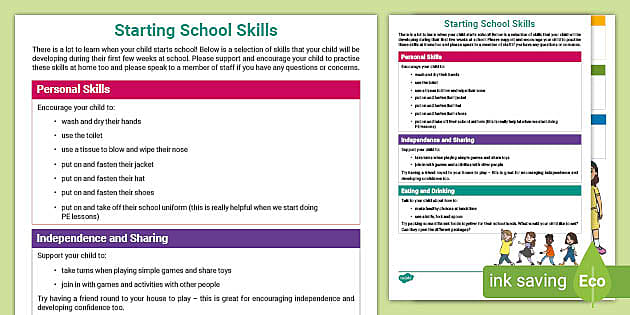
Independence helps children participate in everyday classroom routines with increasing confidence. Kindergarten often involves managing personal belongings, following familiar routines, and completing simple tasks with appropriate support.
Useful self-care and independence skills may include:
- Washing hands with age-appropriate guidance.
- Using the toilet or communicating toileting needs.
- Eating and drinking with suitable assistance.
- Putting away personal belongings.
- Following simple daily routines.
- Asking an adult for help.
- Trying age-appropriate tasks independently.
- Practicing how to put on or remove suitable clothing.
Children develop independence at different rates, and some require accommodations or additional assistance. The purpose is not to expect children to do everything alone but to help them participate as fully as possible.
How parents can help: Encourage children to put toys away, carry a lightweight bag, choose between two suitable outfits, or practice washing their hands.
Allow extra time for learning. If a task is difficult, break it into manageable steps and demonstrate what to do before inviting your child to try.
6. Physical Development and Motor Skills
Physical development supports children’s ability to move around safely, participate in play, and handle learning materials.
Two important areas are gross motor skills and fine motor skills.
Gross motor skills involve larger movements, such as walking, running, jumping, climbing, and balancing. Fine motor skills involve smaller, controlled movements of the hands and fingers, such as drawing, turning pages, using utensils, and manipulating classroom materials.
Useful physical experiences include:
- Running and moving in safe spaces.
- Practicing balance during age-appropriate games.
- Throwing or rolling a soft ball.
- Drawing with crayons.
- Using child-safe art materials.
- Building with suitable blocks.
- Turning pages in books.
- Practicing simple clothing fasteners when ready.
Children do not need perfect handwriting or advanced athletic skills before kindergarten. They benefit from regular opportunities to move, explore, and practice coordination.
How parents can help: Provide time for outdoor play, drawing, building, and creative activities. Adapt games to your child’s abilities and provide suitable assistance when needed.
If your child has a physical disability or requires additional support, discuss classroom accessibility and suitable accommodations with the school.
7. Approaches to Learning and Attention
Approaches to learning include curiosity, persistence, flexibility, and the ability to engage with activities. These qualities can help children participate in classroom experiences and respond to unfamiliar challenges.
Kindergarten activities may involve listening to a story, trying a new puzzle, following a short sequence of instructions, or working alongside other children.
Useful learning habits include:
- Showing interest in new activities.
- Exploring unfamiliar materials.
- Trying again after a manageable difficulty.
- Following simple instructions.
- Moving between activities with support.
- Asking questions.
- Participating in short periods of focused play.
- Seeking help when something is confusing.
Preschool children naturally vary in attention and activity levels. They are not expected to sit still for long periods or concentrate on every task for the same amount of time.
How parents can help: Offer puzzles, building challenges, simple art projects, and imaginative play. Allow children time to explore before stepping in to solve every problem.
If an activity becomes frustrating, provide a small hint or simplify the task. Celebrate persistence and curiosity rather than expecting immediate success.
School Readiness Checklist for Parents
This checklist can help parents notice the types of experiences their children are developing before kindergarten. It is a practical discussion aid, not a formal test or a requirement that every item must be mastered before school entry.
{@body const readinessItems = [
{category:”Social and emotional”,items:[“Practices taking turns with support”,”Begins to communicate feelings and needs”,”Can seek help from a trusted adult”]},
{category:”Language and literacy”,items:[“Enjoys listening to stories or conversations”,”Communicates ideas in an age-appropriate way”,”Shows interest in books, pictures, or print”]},
{category:”Early mathematics and thinking”,items:[“Explores counting and quantities”,”Sorts or matches familiar objects”,”Shows curiosity and tries simple problems”]},
{category:”Independence and routines”,items:[“Practices putting away belongings”,”Participates in basic self-care routines”,”Can follow familiar, simple instructions with support”]},
{category:”Physical development”,items:[“Participates in movement and active play”,”Uses hands for drawing or manipulating materials”,”Can access activities with appropriate support”]}
]}
{@body const [readinessChecked,setReadinessChecked] = DIL.useState([])}
<box border radius=”xl” padding={4} gap={3}>
<row align=”center” justify=”between”>
<title size=”lg”>Kindergarten preparation checklist</title>
<badge color=”secondary”>{readinessChecked.length} of {readinessItems.reduce((total,group)=>total+group.items.length,0)}</badge>
</row>
<text color=”secondary” size=”sm”>Check skills your child is practicing or demonstrating. Unchecked items are simply areas to explore together, not signs of failure.</text>
{#each readinessItems as group, i}
<box key={group.category} gap={2}>
<text weight=”medium”>{group.category}</text>
{#each group.items as item, j}
<checkbox key={item} checked={readinessChecked.includes(item)} onChange={(checked)=>setReadinessChecked(previous=>checked?[…previous,item].filter(entry=>entry!==item))}>{item}</checkbox>
{/each}
</box>
{#if i < readinessItems.length-1}
<divider color=”subtle” />
{/if}
{/each}
<button variant=”outline” block onClick={()=>setReadinessChecked([])}>Reset checklist</button>
</box>
A child’s strengths and needs should be considered together. If you have concerns, talk with the preschool teacher and, when appropriate, a qualified healthcare or child-development professional.
How Parents Can Prepare Children for Kindergarten at Home
Parents can support school readiness without turning the home into a classroom. Small, consistent experiences often fit more naturally into family life than lengthy academic lessons.
Establish Predictable Daily Routines
Regular routines can help children understand what to expect and practice independence. A consistent pattern for waking, meals, play, reading, and bedtime may make the transition to a school schedule easier.
Introduce changes gradually when possible. For example, if kindergarten starts earlier than your current routine, adjust bedtime and waking time over several days or weeks.
Keep routines flexible enough to accommodate family needs, rest, and unexpected changes.
Practice Following Simple Instructions
Kindergarten includes instructions from teachers during group activities, transitions, and everyday classroom routines.
At home, children can practice with simple, clear directions such as putting a book on the shelf, choosing a jacket, and then coming to the door.
Start with one step and gradually introduce short sequences when your child is ready. Avoid interpreting every difficulty as disobedience; children may need repetition, visual reminders, or additional support.
Encourage Cooperative Play
Playing with siblings, relatives, friends, or other children gives preschoolers opportunities to practice communication and turn-taking.
Choose simple games that allow children to cooperate, share materials, or work toward a common goal.
Disagreements are normal. Help children describe what happened, communicate their needs, and consider possible solutions rather than expecting them to resolve every conflict independently.
Read and Talk Every Day
Shared reading supports vocabulary, listening, comprehension, and positive relationships. Conversation also helps children practice explaining ideas and asking questions.
You can discuss a story, describe what happened during the day, or talk about an activity you completed together.
If your family speaks more than one language, use the languages that allow you to communicate comfortably and richly with your child. These conversations are valuable learning experiences.
Visit the School Before the First Day
When possible, visit the kindergarten building, attend an orientation, or participate in an introductory activity.
Seeing the classroom, meeting the teacher, locating the bathroom, and learning where belongings are stored can make the setting feel more familiar.
If a visit is unavailable, talk about what school may be like using age-appropriate language. Avoid making promises about exactly how every day will go, since routines can vary.
Talk Positively and Honestly About School
Children may feel excited, uncertain, or nervous about starting kindergarten. Let them express these feelings without suggesting that they should always be happy or brave.
You might say, “It is normal to feel nervous when something is new. Your teacher will help you learn what to do.”
Share practical information about the school day and answer questions honestly. A reassuring approach can help children feel supported as they prepare for change.
What Should a Child Know Academically Before Kindergarten?
Parents often wonder whether their child must recognize the entire alphabet, count to a particular number, or write their name before entering kindergarten.
Expectations vary by school system and location. In general, children benefit from early exposure to literacy, mathematics, and problem-solving, but they do not need to master the entire kindergarten curriculum in advance.
Helpful early academic experiences may include:
Letters and sounds: Becoming familiar with letters, noticing sounds in words, and recognizing familiar print.
Books and stories: Enjoying shared reading, discussing pictures, and understanding that stories communicate ideas.
Counting and quantities: Counting objects during play, noticing small quantities, and exploring more and fewer.
Shapes and patterns: Recognizing common shapes, sorting objects, and noticing repeating patterns.
Drawing and early writing: Making marks, drawing pictures, experimenting with crayons, and showing interest in written words.
Curiosity and reasoning: Asking questions, testing simple ideas, and trying different approaches to a problem.
Children will continue developing these skills in kindergarten. Focus on enjoyable exploration rather than drilling or comparing your child’s performance with that of others.
How Preschool Teachers and Parents Can Work Together
A positive relationship between families and educators can support children’s transition to kindergarten. Parents know their children’s routines, interests, communication styles, and experiences at home. Teachers understand classroom expectations and can observe how children participate in group learning.
Sharing this information can help both sides provide more consistent support.
Discuss Strengths and Areas for Growth
Ask the preschool teacher which skills your child is developing confidently and which ones could benefit from more practice.
For example, your child might enjoy books and counting activities but need help with transitions or group participation. This information can guide simple activities at home.
Share Relevant Information With the School
If your child has a disability, medical need, communication difference, sensory preference, or other support requirement, discuss relevant arrangements with the school before the transition whenever possible.
This helps staff plan appropriate accommodations, routines, and learning materials.
Ask About Kindergarten Expectations
Schools may differ in their expectations for self-care, classroom routines, literacy, and mathematics. Ask the kindergarten teacher or school administration which skills are helpful and which supports are available.
Use this information as a guide rather than a reason to pressure your child.
Maintain Communication After School Begins
Readiness continues to develop after kindergarten starts. Check in with teachers about your child’s adjustment, friendships, participation, and learning progress.
If concerns arise, work together to identify practical steps and determine whether further support is needed.
Common Mistakes to Avoid When Preparing for Kindergarten
Parents naturally want children to have a positive start, but some preparation strategies can create unnecessary pressure.
1. Focusing Only on Academic Skills
Recognizing letters and numbers is useful, but school readiness also includes communication, independence, social-emotional development, physical abilities, and curiosity.
A balanced approach gives children opportunities to practice all these areas.
2. Comparing Children With Their Peers
Children develop at different rates and have different experiences. Comparing one child’s skills with another’s can create anxiety and overlook individual strengths.
Pay attention to your child’s progress over time and seek guidance when you have specific concerns.
3. Expecting Complete Independence
Young children still need adult assistance. They may require reminders, help managing belongings, emotional reassurance, or accommodations during daily routines.
Encourage growing independence while recognizing that asking for help is also an important skill.
4. Using Excessive Worksheets or Drills
Formal practice can be useful in some situations, but lengthy sessions may not be appropriate for every preschool child.
Use play, conversation, books, movement, and everyday activities to introduce academic concepts in engaging ways.
5. Ignoring Emotional Concerns
A child who appears nervous about school may need reassurance, more information, or gradual opportunities to become familiar with the new environment.
Listen carefully and avoid dismissing concerns. Contact the school if anxiety or adjustment difficulties persist and interfere with everyday activities.
When Should Parents Seek Additional Guidance?
Children develop at different rates, and occasional difficulties are common. However, if you have ongoing concerns about communication, movement, hearing, vision, social interaction, learning, or other aspects of development, it is reasonable to seek advice.
Start by discussing your observations with your child’s preschool teacher or healthcare professional. They may recommend developmental screening, a hearing or vision check, or an evaluation by an appropriate specialist.
Seek guidance if your child consistently struggles to communicate basic needs, participate in everyday activities, respond to familiar instructions, or use skills they previously had. These examples are not a diagnosis, but they can be useful reasons to discuss development with a professional.
Avoid using a general school readiness checklist to diagnose a delay or decide that a child is not ready for school. Checklists can organize observations, but they cannot replace individualized assessment.
Children with disabilities or developmental differences can benefit from appropriate accommodations, specialized services, and inclusive learning environments. The goal is to identify the support that allows each child to participate and learn.
Frequently Asked Questions About School Readiness Skills for Kindergarten
What are the most important school readiness skills for kindergarten?
Important skills include communication, early literacy, basic mathematical understanding, social-emotional development, physical coordination, independence, curiosity, and the ability to participate in routines. No single skill determines whether a child will succeed in kindergarten.
Should a child know all the letters before kindergarten?
Not necessarily. Familiarity with letters, sounds, books, and print can be helpful, but expectations vary by school system. Children continue developing literacy skills during kindergarten, so shared reading and playful exploration are useful preparation.
Should children be able to count before starting kindergarten?
Counting is a helpful early mathematics skill, but children demonstrate different levels of understanding before school. Counting everyday objects, sorting materials, recognizing patterns, and comparing quantities can build useful foundations.
How can parents tell if their child is ready for kindergarten?
Parents can consider how their child communicates, interacts with others, participates in routines, explores learning activities, and manages age-appropriate tasks with support. Readiness is broad and continues to develop. If concerns arise, discuss them with preschool teachers or qualified professionals.
What if my child is shy or nervous about kindergarten?
Shyness or nervousness does not automatically mean a child is unready. Help your child become familiar with the school environment, talk about what to expect, practice simple routines, and acknowledge their feelings. Speak with school staff if the concerns persist or significantly affect daily life.
How can I prepare my child for kindergarten without pressure?
Read together, encourage play, count objects during everyday activities, practice self-care routines, and allow opportunities to interact with others. Keep activities enjoyable, follow your child’s interests, and focus on gradual progress rather than mastery of every skill.
Are social skills more important than academic skills for kindergarten?
Both matter, along with physical development and approaches to learning. School readiness is multidimensional. Children benefit from a balanced foundation that includes communication, early academic experiences, cooperation, independence, and curiosity.
Do children with developmental differences need different preparation?
Some children may benefit from individualized preparation, communication supports, accessible materials, or other accommodations. Parents can collaborate with educators and healthcare professionals to identify the support that best fits the child’s needs.
Conclusion
Understanding school readiness skills for kindergarten helps parents focus on the full range of abilities that support a positive start to school. Early literacy and mathematics matter, but so do communication, emotional development, physical coordination, independence, curiosity, and the ability to participate in everyday routines.
Parents can build these foundations through shared reading, playful counting, creative activities, cooperative games, predictable routines, and opportunities for children to try manageable tasks independently.
Most importantly, kindergarten readiness is not a race or a requirement that children master every skill before their first day. Children develop at different rates and continue learning once school begins.
By working with preschool teachers, responding to individual needs, and creating a supportive home environment, families can help children approach kindergarten with greater confidence, curiosity, and readiness to learn.
Leave a Reply