Understanding academic sources and citations is an essential part of becoming a successful student. Whether learners are writing essays, completing research projects, preparing presentations, or investigating a subject in depth, they need to know how to find trustworthy information and acknowledge the people whose work they use.
However, many students find academic research confusing. They may struggle to distinguish scholarly articles from general websites, decide whether a source is reliable, understand citation formats, or recognize when borrowed information needs to be cited. Without clear guidance, these challenges can lead to weak arguments, inaccurate references, and accidental plagiarism.
Teaching academic sources and citations for students helps learners develop stronger research habits, improve academic writing, and use information responsibly. Students who understand these skills can support their arguments with credible evidence, recognize different perspectives, and communicate their findings more effectively.
This guide explains the main types of academic sources, how to evaluate their quality, why citations matter, and how teachers can help students practice these skills through practical classroom activities.
What Are Academic Sources?
Academic sources are materials used to study, explain, investigate, or analyze a subject. They may include scholarly journal articles, academic books, research reports, conference papers, and publications produced by experts or research institutions.
These sources often provide evidence, explain methods, discuss previous research, or present detailed analysis. However, not every source published by an educational institution is automatically scholarly, and not every useful source needs to be an academic journal article. The appropriate source depends on the research question and the assignment requirements.
Students should learn to identify what kind of material they are using and determine whether it is suitable for their particular purpose.
1. Scholarly Journal Articles
Scholarly journal articles are written by researchers or subject specialists and published in academic journals. They often present original research, review existing studies, or analyze important questions within a field.
Many scholarly journals use peer review, a process in which other experts evaluate a manuscript before publication. Peer review can strengthen the quality of research, although it does not guarantee that every conclusion is correct.
Students should examine the article’s purpose, authors, methods, evidence, and limitations before relying on its findings.
2. Academic Books
Academic books provide detailed explanations of subjects, theories, historical developments, or research findings. They may be written by individual scholars or edited collections featuring contributions from several authors.
These books can help students build background knowledge and understand complex topics. Textbooks are also useful for learning foundational concepts, although some assignments require students to use more specialized or recent research.
Students should check the author’s expertise, publisher, publication date, and relevance to their research question.
3. Government and Institutional Reports
Government agencies, research institutions, universities, and recognized organizations sometimes publish reports containing statistics, policy analysis, surveys, or research findings.
These materials can be useful for topics such as education, public policy, environmental issues, and population trends. Students should investigate how the information was collected, who produced the report, and whether the evidence supports the conclusions.
An institutional report may be authoritative for some purposes but less suitable for others, depending on its methods and intended audience.
4. Primary Sources
Primary sources provide direct evidence from a particular event, period, investigation, or experience. Examples include historical letters, original speeches, interviews, diaries, legal documents, experimental data, and original research studies.
The meaning of a primary source depends on the subject being studied. A newspaper article from a historical period may be a primary source for examining public opinion at that time, while a later historical analysis may be a secondary source.
Learning to identify primary sources helps students understand how evidence is created and interpreted.
5. Secondary Sources
Secondary sources interpret, analyze, summarize, or discuss information from primary sources or earlier research. Examples include historical analyses, literature reviews, and scholarly discussions of existing studies.
These sources can help students understand a topic’s broader context and compare different interpretations.
A strong research assignment may use both primary and secondary sources, depending on the question and the teacher’s requirements.
What Is the Difference Between Academic and Nonacademic Sources?
Academic and nonacademic sources serve different purposes. Understanding the difference helps students choose appropriate evidence for their assignments.
| Feature | Academic sources | General or nonacademic sources |
|---|---|---|
| Main purpose | Research, scholarly analysis, or specialized learning | News, entertainment, public information, opinion, or other purposes |
| Authors | Often researchers or subject specialists | Journalists, organizations, professionals, or individual contributors |
| Evidence | Usually includes documented evidence or references | May include evidence, but the level of documentation varies |
| Audience | Researchers, students, or specialists | General readers or specific public audiences |
| Review process | May involve editorial review or peer review | Review processes vary by publisher |
| Best use | Detailed research, academic arguments, and subject-specific analysis | Background information, current events, public perspectives, or examples |
These distinctions are guidelines rather than absolute rules. A well-researched newspaper investigation may be useful evidence, while a scholarly article may not answer a particular question. Students should evaluate each source based on its credibility, relevance, and intended purpose.
Why Are Academic Sources and Citations Important for Students?
Understanding sources and citations improves more than the appearance of an assignment. These skills help students think critically, support their arguments, and communicate responsibly.
1. Strengthens Academic Arguments
A clear argument needs relevant evidence. Academic sources can provide research findings, historical documents, statistics, expert analysis, or explanations that help students support their claims.
For example, a student arguing that school libraries support learning should look for relevant evidence rather than relying only on personal opinion. The student must then explain how the evidence supports the argument.
2. Develops Critical Thinking
Students should not accept every statement they encounter online or in print. Evaluating sources encourages them to ask who produced the information, what evidence supports it, whether other sources agree, and what limitations may exist.
This process helps students recognize unsupported claims, misleading statistics, and incomplete explanations.
3. Gives Credit to Original Authors
Citations acknowledge the people whose words, ideas, research, and findings contribute to a student’s work.
Proper attribution shows readers which ideas come from existing sources and which parts reflect the student’s own analysis. It also allows readers to locate the original material and examine it independently.
4. Helps Prevent Plagiarism
Plagiarism occurs when someone presents another person’s words, ideas, or work as their own without appropriate acknowledgment. It can happen intentionally or accidentally.
Students may unintentionally plagiarize when they copy a passage into their notes, forget where it came from, and later include it in an essay without quotation marks or citation.
Learning to record source details, paraphrase accurately, and cite information throughout the research process reduces this risk.
5. Improves Research and Writing Skills
When students learn how to select sources and integrate evidence, they can organize their writing more effectively. They become better equipped to compare viewpoints, explain complex ideas, and build logical conclusions.
These skills are useful across subjects and can support students as they progress to higher education and professional learning.
How to Evaluate Academic Sources for Credibility
Students should evaluate sources before using them as evidence. A source may look professional but contain unsupported claims, outdated information, or a perspective that needs to be considered carefully.
Teachers can introduce the following checks.
Check the Author’s Expertise
Find out who created the source and whether their experience or qualifications relate to the topic.
Questions to ask include:
- Is the author’s name provided?
- Does the author have relevant expertise or research experience?
- Is the author affiliated with an institution or organization?
- Can the author’s background be verified through independent information?
An author may be qualified in one field but not another. Students should consider whether the author’s expertise matches the specific claim being made.
Examine the Publisher
Identify the journal, academic press, institution, organization, or website responsible for publishing the material.
Consider whether the publisher has an editorial process and whether its purpose is clear. Students should also be aware of commercial interests, advocacy goals, and other factors that may influence how information is presented.
A domain ending in .edu, .org, or .gov can provide context, but the domain alone does not establish that every page is accurate or suitable for academic research.
Check the Evidence
Reliable sources should provide enough information for readers to understand how their claims are supported.
Look for research methods, references, data, examples, original documents, or explanations of the evidence used. For research studies, students should consider whether the methods and findings are appropriate for the conclusions being made.
When an important claim cannot be verified, students should look for additional credible sources before relying on it.
Consider the Publication Date
The importance of a source’s age depends on the topic.
For subjects such as current technology, recent policies, or developing scientific research, newer evidence may be necessary. For history, literature, or the study of older theories, original or older sources may be essential.
Students should consider when the information was published, whether it has been updated, and whether more recent evidence changes its interpretation.
Identify Purpose and Perspective
Ask why the source was created. Is it intended to inform, persuade, sell, entertain, or advocate for a particular position?
A source may have a clear perspective without being useless. The important task is to understand that perspective and evaluate whether the evidence supports its claims.
Students should also look for missing viewpoints and compare sources when a topic involves disagreement.
Compare With Independent Sources
One of the strongest ways to check an important claim is to compare it with information from other credible sources.
Students should investigate whether independent researchers or organizations report similar findings. If sources disagree, they should examine the methods, evidence, dates, and context rather than choosing whichever source agrees with their initial opinion.
What Is a Citation?
A citation is a reference that acknowledges information taken from another source. It helps readers identify where a quotation, paraphrase, summary, statistic, or other borrowed information originated.
Academic assignments generally use two connected elements:
In-text citation: A short reference placed within the main text near the information being used. Its format depends on the required citation style.
Reference list or bibliography: A list of source details that helps readers identify and locate the materials used.
The names and formatting of these elements vary by style. For example, APA generally uses a reference list, while MLA commonly uses a Works Cited page. Some assignments may request a bibliography containing a broader range of consulted materials.
Students should always follow the citation style specified by their teacher or institution.
Common Academic Citation Styles Students Should Know
Different academic fields use different citation systems. Students do not need to master every style at once, but they should understand how to identify and follow the format required for an assignment.
APA Style
The American Psychological Association (APA) style is commonly used in psychology, education, and some social sciences.
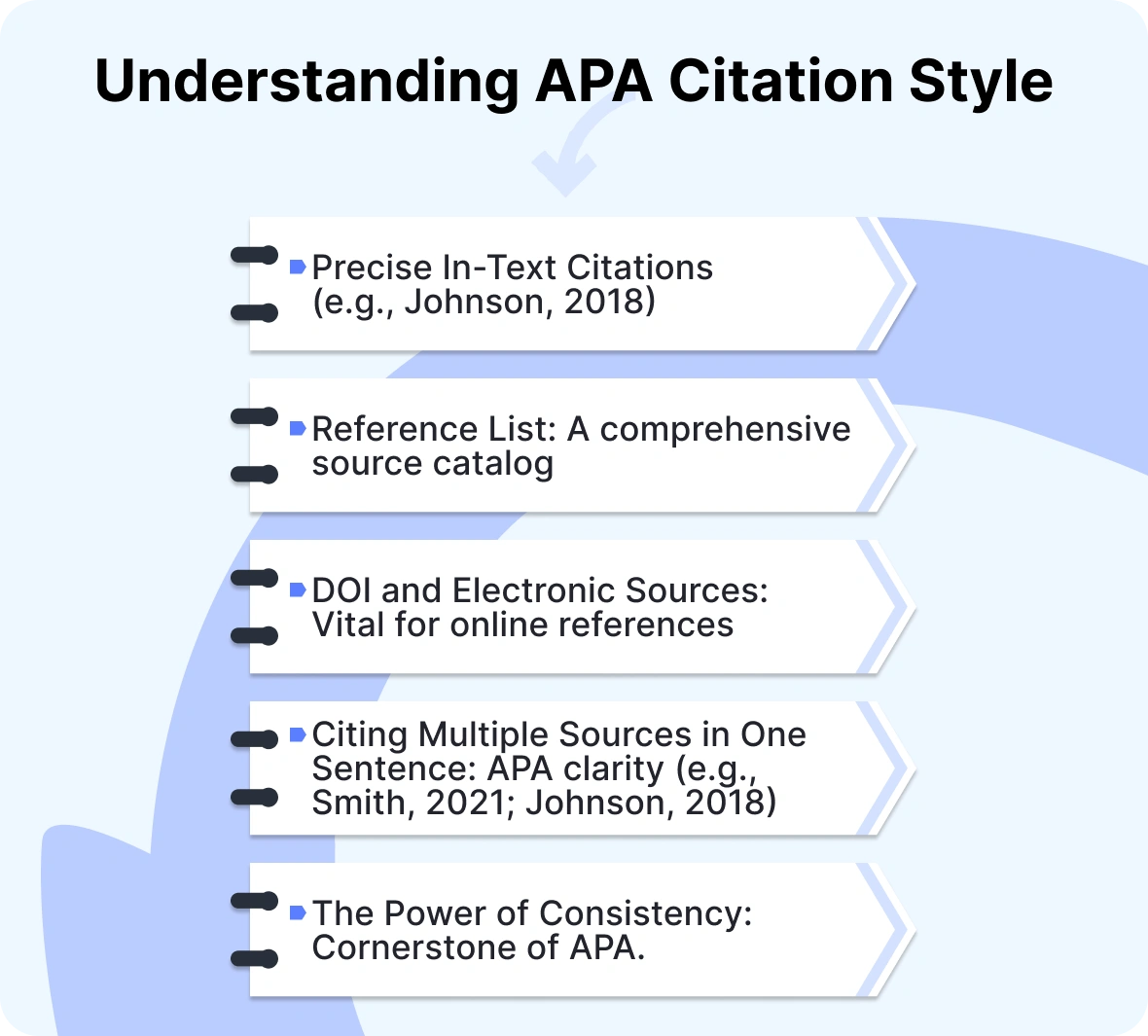
APA generally uses author-date citations in the text. For example, a paraphrase might appear as:
Educational researchers examine how classroom practices influence student learning (Taylor, 2024).
This is an illustrative example, not a reference to a specific published study.
The reference list provides the fuller publication details needed to locate the source.
MLA Style
The Modern Language Association (MLA) style is widely used in literature, language studies, and other humanities subjects.
MLA commonly uses the author’s surname and a page number for in-text citations when a page number is available.
An illustrative example might be:
Literary analysis considers how a character’s choices influence the development of a story (Taylor 42).
The corresponding Works Cited entry identifies the publication.
Chicago Style
Chicago style is used in several disciplines, including history and some humanities subjects. It offers different documentation systems, including notes and bibliography and author-date.
In the notes-and-bibliography system, a student may use a footnote or endnote to identify a source. A bibliography can then provide fuller publication information.
The appropriate system depends on the assignment’s instructions.
Why Students Should Not Mix Citation Styles
Each citation style has its own rules for punctuation, author names, dates, page numbers, titles, and reference formatting.
Mixing styles can make references inconsistent and difficult to follow. Students should choose the required style at the beginning of a project and apply it consistently.
If instructions are unclear, they should ask the teacher rather than guessing.
When Should Students Cite Academic Sources?
Students should cite sources whenever they use information that comes from another person’s work and is not their own original contribution or genuinely common knowledge.
Citation is generally needed for the following:
- Direct quotations copied word for word.
- Paraphrased ideas expressed in new wording.
- Summaries of another author’s argument or research.
- Statistics, data, and research findings.
- Specific claims that rely on a source.
- Images, charts, diagrams, and other materials when attribution or permission is required.
- Original theories or interpretations developed by another author.
Students do not usually need to cite genuinely common knowledge, such as widely established basic facts, but the distinction can depend on the subject, audience, and assignment.
When a student is uncertain, citing an appropriate source or asking the teacher is safer than assuming attribution is unnecessary.
How to Cite Sources Correctly: A Step-by-Step Guide
Students can make citation easier by building it into the research process rather than treating it as a final formatting task.
Step 1: Record Source Details During Research
As soon as students find a useful source, they should save the information required to identify it.
Depending on the source, this may include:
- Author or organization.
- Title of the article, book, or webpage.
- Journal or publication title.
- Publisher and publication date.
- Volume, issue, and page range when applicable.
- DOI or URL when required by the citation style.
Recording these details early prevents students from having to search for missing information later.
Step 2: Mark Quotations Clearly
If students copy exact wording into their notes, they should immediately place it in quotation marks and record its location, such as a page number when available.
This is especially important when students are taking notes from several sources. Without clear labels, they may later mistake the original author’s wording for their own.
Step 3: Paraphrase Accurately
Paraphrasing means explaining a source’s idea using genuinely different wording and sentence structure while preserving its meaning.
Students should first understand the passage, then set the original text aside and explain the idea independently. They should compare their version with the original to check accuracy and avoid overly similar wording.
A paraphrase still requires citation because the underlying idea comes from another source.
Step 4: Add In-Text Citations
Place the citation near the quotation, paraphrase, or other borrowed information according to the required style.
Students should check whether the style requires an author, date, page number, footnote, or another identifying detail for that particular type of source.
Step 5: Prepare the Reference List
At the end of the assignment, include the required list of sources in the correct format. Check that the details are complete and that the entries correspond to the sources cited in the text, following the rules of the selected style.
Students should verify author names, titles, dates, page ranges, and publication details rather than relying on memory.
Step 6: Review Every Citation
Before submitting an assignment, students should ask:
- Have I cited every borrowed idea that requires attribution?
- Are direct quotations marked accurately?
- Do the in-text citations follow one consistent style?
- Can readers identify the full sources from the reference list?
- Have I verified that the sources exist and support the claims?
- Have I followed the teacher’s instructions?
A final citation review helps catch errors that may otherwise weaken an otherwise strong assignment.
Examples of Academic Citations and Source Use
The following examples are illustrative and use fictional publication details to demonstrate how students can integrate evidence responsibly.
Example 1: Using a Paraphrase
Suppose a fictional educational report explains that regular reading opportunities can help students develop vocabulary.
A student might write:
Regular opportunities to read can expose learners to a wider range of words and language structures (Morgan, 2023).
The sentence restates the source’s idea in new wording and includes an illustrative APA-style in-text citation.
The corresponding reference entry would need the actual title and publication details of the report. The student should never invent publication information to complete a citation.
Example 2: Using a Direct Quotation
If a source contains wording that is especially important to the student’s analysis, the student may quote it directly:
The author states, “Students benefit from regular opportunities to discuss what they read” (Morgan, 2023, p. 18).
This example demonstrates the general pattern of a quotation with an author, date, and page number. The quoted sentence and publication details are fictional.
In a real assignment, the quotation must match the original source exactly, and the student must follow the required citation style.
Example 3: Integrating Evidence Into an Argument
A student writing about classroom reading might combine source evidence with personal analysis:
Regular reading opportunities can help students encounter new vocabulary (Morgan, 2023). Teachers can build on this benefit by providing books that match students’ interests and encouraging them to discuss unfamiliar words.
The first sentence attributes a source-based idea. The second presents an application or recommendation developed by the student. If the recommendation is also based on a specific source, that source should be cited as appropriate.
This example shows how citations can support an argument without replacing the student’s own reasoning.
How to Teach Academic Sources and Citations in the Classroom
Students learn research practices more effectively when teachers demonstrate the process, provide guided practice, and give feedback before major assignments are due.
1. Begin With Source Comparison
Present students with two or three sources about the same topic, such as a scholarly article, a news report, and a personal blog post.
Ask them to identify the author, purpose, evidence, audience, and publication context. Discuss which source is most appropriate for a particular research question and why.
This activity teaches students that source quality depends on both credibility and relevance.
2. Demonstrate How to Find Scholarly Articles
Show students how to use a school library catalog, academic database, or scholarly search service. Explain how to recognize article titles, author information, publication details, abstracts, and reference lists.
If students use database filters for peer-reviewed material, remind them that they still need to confirm whether a source is suitable for the assignment.
3. Practice Citation Formatting
Give students a set of sample source details and ask them to format the entries using the required citation style.
Start with straightforward sources, such as a book or journal article, before introducing more complicated examples. Students should learn why each piece of information is included rather than simply copying a template.
4. Teach Paraphrasing and Citation Together
Provide a short paragraph and ask students to identify its main idea, write a paraphrase, and add an appropriate citation.
Discuss why changing only a few words is insufficient and why the original source must still be acknowledged.
Combining these skills helps students understand that original wording and source attribution are related but separate responsibilities.
5. Use Citation Error-Checking Activities
Prepare a sample reference list containing common errors, such as missing dates, inconsistent punctuation, incomplete titles, or mismatched author names.
Ask students to identify the problems and correct them using the required style guide.
This activity encourages careful checking and shows students that citations need attention, just like other parts of academic writing.
6. Include Source Evaluation in Research Assignments
Instead of assessing only the final essay, ask students to submit a brief source evaluation or annotated bibliography during the research stage.
Students can explain why each source is relevant, what evidence it provides, and what limitations they noticed.
This checkpoint gives teachers an opportunity to address weak source choices before students build their arguments around them.
Classroom Activities to Help Students Understand Citations
Practical activities can make source evaluation and citation rules easier to understand.
Activity 1: The Reliable Source Challenge
Give students a research question and several sample sources with different authors, purposes, evidence, and publication dates.
Students should rank the sources for a particular research task and justify their decisions. Emphasize that a source’s usefulness depends on the question being investigated.
Activity 2: Citation Matching
Provide a set of sample in-text citations and reference entries. Ask students to match each citation to the corresponding source.
Include examples with similar author names or publication dates so students must pay attention to details.
Activity 3: Find the Missing Citation
Present a short sample essay containing a mixture of original analysis, paraphrased ideas, statistics, and direct quotations.
Ask students to identify which statements require citations and explain their reasoning.
Use fictional material or properly attributed classroom examples to avoid reproducing another writer’s work without permission.
Activity 4: Build a Reference List
Ask students to collect details from a small set of sources and prepare a reference list in one assigned style.
Students should check spelling, dates, titles, and formatting, then compare their work with a trusted style guide.
Activity 5: Explain the Source Choice
Have students select one source for a research project and write a short explanation covering the author’s expertise, evidence, relevance, and limitations.
This activity develops the habit of justifying source choices rather than assuming that every search result is reliable.
Common Citation Mistakes Students Should Avoid
Even students who understand the basic rules can make mistakes when working with multiple sources.
Forgetting to Cite Paraphrased Ideas
Students sometimes believe that changing the wording removes the need for attribution. It does not. The source must generally be cited when its ideas are paraphrased or summarized.
Copying Text Without Quotation Marks
Copied wording should be clearly marked as a direct quotation and cited appropriately. Students should label quotations during note-taking rather than trying to identify copied material after completing a draft.
Using Incomplete Source Details
A reference with a missing author, incorrect title, or broken URL may be difficult to verify. Students should record details carefully and check them before submission.
Mixing Citation Styles
Switching between APA, MLA, and Chicago can create inconsistent references. Students should follow the style required for the assignment and use it consistently.
Citing Sources They Have Not Checked
A source mentioned in another article is not necessarily one the student has read. Students should avoid implying that they consulted an original work unless they actually did so. If the original source is unavailable, they should follow the required style’s guidance for citing a secondary source.
Relying on Citation Generators Without Reviewing the Result
Citation generators can save time, but they may contain incorrect or incomplete information. Students should verify every entry against the original source and the relevant style guide.
Trusting AI-Generated References Without Verification
AI tools may produce citations that look plausible but refer to nonexistent publications or misrepresent real sources. Students should locate each source independently and confirm that it supports the claim for which it is being used.
How Students Can Use AI Responsibly When Working With Sources
AI tools can sometimes help students brainstorm search terms, understand unfamiliar terminology, or organize a research plan. However, they should not replace source evaluation or independent verification.
Students should follow their school’s rules on permitted AI use and disclosure. They should also take care not to upload private, confidential, or sensitive information into tools without authorization.
Before using a source suggested by an AI tool, students should:
- Search for the publication using its title and author.
- Confirm that the source actually exists.
- Check the publication details against the original record.
- Read the source rather than relying solely on a generated summary.
- Verify that the evidence supports the claim being made.
- Cite the actual source they consulted according to the required style.
AI-generated text is not a substitute for evidence. Students remain responsible for the accuracy, attribution, and integrity of their final work.
How Teachers Can Assess Source Evaluation and Citation Skills
Assessment should measure whether students understand how and why to use sources, not just whether they can reproduce a citation format.
Teachers can evaluate these skills through several methods.
Source evaluation worksheet: Students explain who created a source, what evidence it provides, and why it is appropriate for the research question.
Annotated bibliography: Students summarize each source, assess its usefulness, and explain how it contributes to the project.
Citation practice: Students format references and correct errors using the required style guide.
Research draft review: Teachers check whether borrowed ideas are cited, quotations are marked, and evidence is integrated into the student’s argument.
Reflection task: Students describe how they selected their sources, verified information, and acknowledged other authors’ work.
A simple rubric can assess four areas: source credibility, relevance of evidence, accuracy of citations, and responsible use of information. Clear criteria help students understand what successful research looks like and what they need to improve.
Conclusion
Helping students understand academic sources and citations prepares them to conduct stronger research, write more convincing arguments, and use information responsibly. Students need to know how to distinguish different source types, evaluate credibility, select evidence that fits their research questions, and acknowledge the work of other authors.
Teachers can make these skills more accessible through source comparisons, citation practice, guided research projects, and regular feedback. Students should also learn to verify publication details, paraphrase accurately, and use digital and AI tools carefully.
By teaching academic sources and citations as part of the complete research process, educators can help students become more confident, independent, and responsible learners. These habits support academic success and provide a valuable foundation for future study and lifelong learning.
Frequently Asked Questions
1. What are academic sources?
Academic sources are materials used for scholarly research, analysis, and learning. They include journal articles, academic books, research reports, primary sources, and other relevant materials produced or reviewed by knowledgeable authors and organizations.
2. What is the difference between an academic source and a regular website?
Academic sources generally provide documented evidence, detailed analysis, and identifiable authors or publishers. General websites vary widely in purpose and reliability. Some nonacademic sources are useful, but students should evaluate each source based on its evidence, author, purpose, and relevance.
3. Why do students need to cite academic sources?
Citations acknowledge other people’s work, help readers locate the original information, support academic arguments, and reduce the risk of plagiarism. They also allow readers to check whether the evidence supports the student’s conclusions.
4. What are the most common citation styles?
APA, MLA, and Chicago are widely used citation styles. APA is common in psychology and education, MLA is widely used in literature and the humanities, and Chicago is used in several fields, including history. Students should follow the style specified by their teacher or institution.
5. Do students need to cite paraphrased information?
Yes. Paraphrasing changes the wording and sentence structure but still uses an idea from another source. Students should cite the original source according to the required citation style.
6. How can students tell whether an academic source is reliable?
Students should examine the author’s expertise, publisher, evidence, references, publication date, purpose, and relevance. Comparing important claims with other independent, credible sources can provide additional confidence.
7. Can students use websites in academic assignments?
Yes, when the websites provide relevant, trustworthy information and meet the assignment’s requirements. Government resources, institutional reports, reputable organizations, and other well-supported webpages may be appropriate. Students should not assume that a domain name alone guarantees accuracy.
8. Are citation generators accurate?
Citation generators can help organize source details, but they may omit information or use incorrect formatting. Students should verify the details against the original publication and check the required citation style.
9. How can students avoid plagiarism?
Students should record source details during research, use quotation marks for exact wording, paraphrase carefully, cite borrowed ideas, and review their work before submission. They should also follow their school’s academic integrity policies.
10. Should students cite AI-generated information?
Students should follow their school’s rules and the required citation style for any permitted use of AI tools. They should verify claims against original, credible sources and cite those sources when using their information. If the assignment requires disclosure of AI assistance, students should provide it accurately.


Leave a Reply